Dear Students,
Vote for the best presentation made this semester. Justify your choice.

English Conversation Course for Part-Time Students
Sunday, 11 June 2017

Saturday, 10 June 2017
Week 7 [05-11.06.2017] World of cosplay

Cosplay is one of the most known kind of
entertainment, but not everyone likes it. That’s because it is unconventional
kind of entertainment. You wear special outfits, and go through town to meet
people who like it, just like you.
Once I made my own cosplay and went to a
special event called convention.
That one was called “Balticon”. When I was walking through the town a stranger
came to me and said “Nice cosplay, I admire you, I’m not so brave to do it”.
Some strangers stared at me in a special, negative way. That’s my story of
cosplay and I want to show you why it is so popular.
To start with, you may think, that cosplay
comes from Japan United States
To start with, a Japanese artist Junichi
Nakahara, who had been inspired by Yumeji Takehisa (an artist, who made his own
brand of clothes) had an idea to design clothes in the manga style. Thanks to
him young girls could buy outfits of the characters, which they liked the most.
The first cosplay was created in USA Japan
Nowadays
there are enormous number of conventions. Some of them have also competitions
of the best cosplay with big money prize. Most of cosplayers made costumes by
themselves, sew step by step and learn how to make good and real-looked makeup.
It cost many time but effects are worth that lost time. Some of them do it for
fun others for money and fame. There are lists of best cosplayers.
Here you have 2 famous
Europe cosplayers: Italian Leon Chiro and LittleJem from Great Britain

Here is
Julia Cosplayer – girl from Asia

Sources:
Tuesday, 6 June 2017
Week 7 [05-11.06.2017] DevOps Culture
I want to
present the topic which I have been interested in for past 2 years. In my company I am
responsible for creating and promoting “DevOps” culture. The reason I have
chosen this topic is because it is very modern in the IT world now, and many people have
probably heard of it; still, the whole context is very extensive and covers many issues.

What does DevOps mean?
First of all, DevOps word is clipped compound of Dev – “software Development” and Ops – “information
technology OPerationS”. To define these two terms separately I want to present to you this “tweet”.
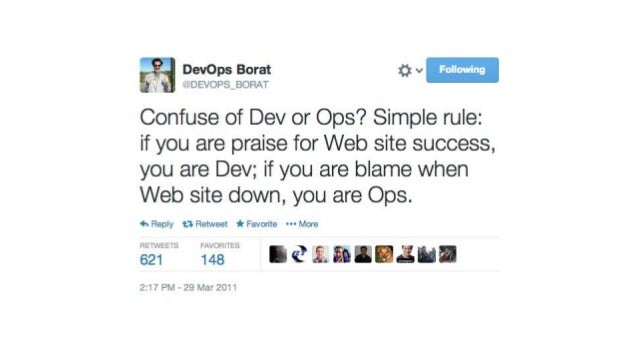
The development team is
responsible only for creating changes in their products and adding and
modifying new features. Most of developers do not know, or simply are not interested in the way their product is deployed
on the market. Developers are
only focused on producing more and more lines of code. The development phase ends on Friday at 4 PM and then the operation phase
starts. The operation team is responsible for creating stable
production environment and enhancing services. If the provided code does
not work, operation teams are
not able to deploy it. A fight between these two teams starts, one blames the other and the whole
situation brings negative consequences and delays in product delivery.
DevOps philosophy is a solution to such a problem.
DevOps is also a culture of product development that can be easily
deployed and operates on the market effectively. It aims at establishing a process which will help to
build, test, and release software more rapidly, frequently and reliably. DevOps
is connected with tools. There is
no single tool which can create DevOps toolchain. In this culture your
code/product is placed in an environment that contains many tools which help
you to develop, build, test, package, release, configure and monitor your
product more efficiently.
This periodic table of DevOps
tools shows how many interesting technologies you can meet in touch with DevOps
culture.

As you can see DevOps is a very
fluent term and many companies can define it in their own way. I want to
present you a definition of DevOps by Amazon and Chef:


Automatization


DevOps term is inseparably
related to automatization. Automatization process can eliminate human mistakes, repeatable tasks can be replaced with common procedures.
Application deployment automation
ensures that companies gain easy deployment and self-documented procedures.
This automated pipeline ensures that a companies gain fast feedback if
something wrong happens (all problems can
be solved quicker).
As I wrote above DevOps is a
process, so DevOps automation is not something that is done once and forgotten. Just like monitoring environments or
checking security, automated pipelines need to be continuously monitored and
improved.
DevOps and automation rely always on OpenSource. These open tools
attract support from the developers’ community, which means that if a tool is repeatedly
developed by thousands of people, it indicates that this is a reliable tool. I
want to present some open source tools in the next paragraph.
OpenSource
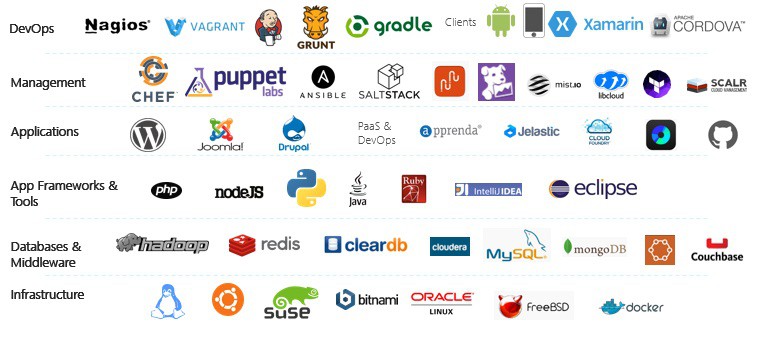
In the above picture you
can see many open source tools and frameworks used both in DevOps and
infrastructure or databases software.
People prefer to use open source
tools because they have more control of it. A collaborative approach is the
best way to create software that will be connected and involved in DevOps culture.
DevOps are not just a set of
tools that let you faster and better. DevOps minimize, e.g. challenges of
shipping, help people cooperate better, create products faster and better.
DevOps remove boundaries between
Developers and Operations.
Questions:
1. Have you ever met with the term
of „DevOps”, how do you understand and use it?
2. Automatization can eliminate
errors and speed up development process. During your daily routine in work, do
you see tasks which you can automate?
3. Does your company use
“OpenSource” products or rather commercial software? Do you see any cons of
using “OpenSource” frameworks?
Sources:
http://www.baringa.com/our-thinking/baringa-blogs/january-2015/why-everyone-is-talking-about-devops/
Week 7 [5-11.06.2017] Morality in technical future.
Today I would like to present an important problem in our life. Every day many scientists create systems and algorithms that help in everyday activities. In a few years machines can directly decide about our lives.
1. Driverless cars

I think that in a few years self-driving cars will be common. This sounds great, but can you think of dangerous situations (accidents, children playing football near a street etc.). The programmers should make software responsible for detecting such situations. Do you know `The trolley problem`? I think it is the most important problem for such technologies.
Please. Visit this page and play a simple game. This shows many moral situations on the roads.
Do you have any suggestions for producers of driverless cars?
2. Big Data analysis systems

Probably all of us have a smartphone with open mobile data (I do not always disable mobile transfers on my device). Many companies (e.g. Google - manufacturer of Android) can grab our all data (history of moving - GPS location), private emails or photos etc. They know us more than a close family or friends. It is horrible. At the moment this data is used to market, but in a few years, e.g. HR applications in our new company can use this type of data.
Please watch a short video about this danger.
What is your opinion of the usage of sensitive data?


3. Machine learning.
In my opinion this is the most dangerous of morality. Programmers cannot controls all of decision tree in this type of algorithms, because algorithms itself modify works based by training data. This is blackbox.
If this training data will be specially crafted and algorithms will decide about our life. I am afraid of this.
Secondly, this training data can have (special or not special) harmful elements and software with machine learning mode should validate this data. Any bug in the first step in learning can change the operating principle of this machine.
And the other hand machine learning can be usage for win in election.
This is moral?
https://hackernoon.com/did-donald-trump-use-artificial-intelligence-to-win-the-election-8008c2c0bf59
Do you have any examples for good or immoral usage machine learning ?
Machine learning is often usage for humanoid robots. Please read this interesting article.
On the other hand humanoid robots probably will be usage in army . Many robots will be fought with real peoples. However any problem in software can be huge dangerous. This type of machine should be very resistant to hacking.
Secondly, In my opinion humanoid robots cannot be fully autonomous. The most important processes and events should be validated by human operators if this robots were created to decide about any dangerous topics.
other source:
http://www.csoonline.com/article/3139923/security/how-big-data-is-improving-cyber-security.html
Week 7 [5-11.06.2017] Viking Gods
 |
| Odin |
You might know them because they appear in literature, comic books, movies. Many music bands were inspired by Nordic myths as well. Amon Amarth, Warduna, Honor recorded many albums set in this theme. But do you know their story?Mightiest of their gods is Odin, also known as Wodan. The third day of the week was sacrificed to him and thou it’s called Wednesday (Wodans day). Two ravens named Huginn ("thought") and Muninn ("memory") are his messengers and spies, gathering information from all worlds for him. His urge for wisdom is so strong that he even decides to hang himself on a tree (Yggdrasil) and gets pierced with his own spear because he knows that he will gain knowledge in the end. Being hanged for nine days gives him knowledge of runes, Nordic alphabet. Other time he sacrificed his eye to drink water from the Well of Wisdom. Odin blessed his followers with a special gift of battle rage. Those who earned it became deadliest of all Viking warriors – Berserkers.
While Odin is a god of war, warriors and power Loki is the symbol of jealousy and treachery. He is ever cunning god and his plans always make him end up bad. But even though he constantly seeks a way to hurt other gods most of his plans fail and results are quite positive. For example, a magic hammer, Mjöllnir, the most powerful weapon in the world - wielded by Thor was made by dwarfs as an effect of one of his intrigues. But if he irritated them so much, played his tricks against each of them, why wouldn’t they just kill him? After all , they were brutal gods of Vikings. But they couldn’t because he was a blood brother of Odin and none of them wanted to test his anger.Thor is a son of Odin. He was considered most kind to the mankind of all the gods. Even Odin, who created a man wasn’t liked as much and that was probably to his mysterious nature. When thunder stroke Norseman believed that it’s Thor hitting his anvil with a hammer. You can also find his name in one of the days of the week. Guess which one.. Thursday. People who seek his protection wore a pendant symbolizing his favored weapon – mentioned above Mjöllnir.
 |
| Mjølnir |
Nordic myths and legends
Images:
Odin: Wägner, Wilhelm. 1882. Nordisch-germanische Götter und Helden. Otto Spamer, Leipzig & Berlin. Page 7.
Mjølnir: www.themedievalstore.com
Monday, 5 June 2017
Week 7 [5-11.06.2017] Tricks of brands to manipulate us
Tricks of brands to manipulate us
Let's
not fool ourselves, companies are prepared to seduce us when we go
shopping. They have studied our brains and they know more than ever
what inspires us when it comes to buying. They use the information to
hide the truth, to manipulate our minds and convince us to buy more
than we need.
For
example, it is pretty common for companies to spray their vegetables
with water to appear more attractive to us or even research how many
bananas should be in one bunch. Even Coca- cola measures how many
bubbles should be shown in their commercials.
 |
Children
are a top priority for business because 53% of adults use brands they
remember from their childhood. The younger we are when we start using
a brand or a product, the more likely we will continue to use it in
the future. That's why, at the age of 18, many teenagers receive a
gift from Gillette with the slogan „Welcome to manhood.” Shell,
meanwhile, has an agreement with Lego to make its brand appear
in toys.
 |
 |
Usually,
companies enjoy activating our most hidden insecurities, such as fear
of germs. The most popular method is called “the purity strip”.
On almost every jar, we see a small piece of paper, holding the lid,
which is a very simple trick assuring the product freshness. In
addition, by unscrewing the jar, we hear that comforting click
(noise) that increases our confidence. This sound, created in a
laboratory, manipulates us. Likewise, hotels use a similar technique
placing a strip of paper on toilet seats and on the bathroom cups to
create the illusion that no one else has used that toilet or drink
from that cup.
 |
We
all like to think that what we consume is natural. Our irrational
minds are convinced that the products are cooler when they are in a
bed of ice - especially, when the soda or the juice sweats a little.
The cooler machines for drinks intentionally keep the exact low
temperature, just for this sweating to appear on bottles. In the same
way, it is also known that supermarkets have been spraying vegetables
with water for years.
 |
|
uploads/2016/12/wet_red_apples_800.jpg
|
We
must not forget that one of the secret ingredients of some successful
brands is “desire”. That's what drives us to go to the fridge at
two in the morning or what drives us to devour the whole bag of
chips.
In
short, knowing the tricks that companies use to seduce us, will not
stop us from buying, but it makes us more conscious. And now, we are
ready to raid the mall.
- Are you aware of advertising manipulation?
- Do you think those tricks affect your life?
- Do you know more tricks used by famous brands?
Sources:
„Brandwashed:
Tricks Companies Use to Manipulate Our Minds and Persuade Us to Buy”
by
Martin Lindstrom
Book
Link:
https://books.google.pl/books?id=17op5NDsZBMC&printsec=frontcover&dq=brandwashed&hl=pl&sa=X&ved=0ahUKEwivt6ymqZXUAhUH2SwKHbc1C3cQ6AEIJjAA#v=onepage&q=brandwashed&f=false
Sunday, 21 May 2017
Week 6 [22-28.05.2017] Bieszczady
I grew up in a small village in the Bieszczady mountains, near the town of Lesko. I was inspired to write this post by TV series such as "Wataha" and the Discovery Channel "Przystanek Bieszczady". These productions certainly increase the interest in this beautiful part of Poland which is Bieszczady. During holidays and long weekends, you can see a lot of tourist traffic. Personally, I would like to show you some places in the Bieszczady mountains, which are just as beautiful but less often visited by tourists. I have prepared for you an idea for a tour in Bieszczady.
Duszatyńskie Lakes - these lakes are located by a red trail (Główny Szlak Beskidzki - the main trail of the Beskidy), between Komańcza and Chryszczata Mount. The area on which they are located is protected - a nature reserve called "Zwiezło", covering 2,2 ha. The name of the reserve relates directly to the events of the year 1907, when the lakes were formed. The western slopes of Chryszczata were weakened by a long rainfall, which caused a landslide of ground and the forest, coming down in the direction of Olchowaty creek, blocking it and the water flow, forming 3 landslide lakes. It is worth mentioning that they are the largest landslide lakes in the Polish part of Beskidy. Two of them have survived to the present day - the third was drained to facilitate fishing (which was the passion of count Potocki, the then landowner).

Zagórz - according to a local tradition, King Casimir the Great rested here while traveling to Rus, founded a Gothic chapel and painting of the Annunciation, famous for miracles related to it. Since that time, Zagórz is an important pilgrimage center of Mary's cult. It was strengthened at the beginning of the 18th century, with the construction of Carmelite monastery defense complex. However, as of today remain only the impressive ruins, one of the few examples of a fortified monastery in Poland. Made from the local sandstone, it had an octagonal nave and two side chapels. From this large object, now remaining are the walls of the Church, the stairs to the choir and fragments of frescoes. In 1772, during a siege, part of the monastery was on fire, and the latter attempts to rebuild it failed to save it from a gradual descent into ruin. From the courtyard you can admire the wide panorama of the lower part of the Bieszczady mountains.

Sobień castle - ruins of the Sobień castle are located in the valley of San. The castle was the home of the Kmita family. It was destroyed in 1474 by Hungarian troops, in retaliation for the destruction in Upper Hungary caused by Pawel Jasiński. As of today, only fragments of the powerful defensive walls and the remains of towers and residential buildings remain of the medieval fortress. One of the most beautiful panoramas of the San river valley, unchanged despite hundreds of years of history, stretches from the terrace here.

Lesko town - it is a town often called the gate to the Bieszczady. Almost every tourist who goes to the Bieszczady mountains passes it. Very few tourists know that Lesko has one of the oldest Jewish cemeteries in Poland. Because of the age of preserved gravestones, the Jewish cemetery in Lesko is considered one of the most valuable necropolises in Poland. On about 3.2 hectares preserved to this day are over two thousand gravestones. The oldest preserved one is from 1548.

Not far from the Jewish cemetery located is a synagogue. The impressive building was built in the years 1626-1654. Although at first glance it resembles a castle rather than a temple, it is still a remnant of the Jewish place of worship. Its unique appearance made the experts of the subject acknowledge it as one of a kind in Poland. The defensive shape of the synagogue, however, has its historical roots. In the year 1526, King Zygmunt III Waza issued an edict in which he ordered the construction of fortified synagogues, to be included in the system of defensive walls of the country.

Kmita Castle - The construction of the castle began in 1538 on the site of a former wooden building. It was initiated by the Kmita family, which moved to Lesko from nearby Sobień. In the following years, the castle was the seat of the aristocratic families such as: Stadnicki, Mniszech, Ossoliński and Krasicki. Currently the castle serves as a guesthouse.

Another little-known attraction is the Lesko Stone. Lesko Stone is a protected monument of inanimate nature. The main rock is a 20-metre sandstone. Its top looks like it was carved by a sculptor. According to a legend, it is a girl cursed in stone. You can often see here stretched ropes - Lesko Stone is used as a climbing wall and more commercially - e.g. for Tyrolean rides. Due to the location along the main trail in the Bieszczady Mountains, Lesko Stone is mentioned in the literature several times. The beauty of the stone inspired Aleksander Fredro to write a special poem about it (Kamień nad Liskiem - A Stone above Lisko), the Stone is also featured in several other of his works. The Stone inspired also other writers, including Wincenty Pol, Oskar Kolberg and Stanisław Staszic.

Our trip ends in Uherce Mineralne. This village is one of the oldest towns in Bieszczady. The name of the village indicates the participation of the Hungarian population in setting it. At the railway station in Uherce Mineralne, tourists have the opportunity to rent a rail draisine. Bieszczadzkie Drezyny Rowerowe [Bike Draisines of Bieszczady] is a venture combining tourism and passion for the railway tradition. This - undoubtedly - most beautiful railway in Poland is over 140 years old! The railway line 108, which is used by the draisines, was built in 1872 on the order of the authorities of the Austrian Empire. It connected the First Hungarian-Galician Iron Railway with the railway line no. 96. You can admire it traveling this part of your trip with rail-cycle draisines, which are - like bikes-powered with the muscles of your legs. From the station in Uherce Mineralne, tourists can choose to ride (according to the timetable) in two directions: Ustrzyki Dolne or Zagórz.

1. Have you ever been in Bieszczady ?.
2. Would you like to move here ?.
3. Would you like to spend your next holiday in the Bieszczady ?.
Subscribe to:
Posts (Atom)